
Grease Trap Installation, Repair & Replacement in Fullerton, CA
Fullerton Elite Grease Trap Cleaning installs, repairs and replaces grease traps and grease interceptors for restaurants, food trucks and commercial kitchens in Fullerton, CA, from a small under-sink trap swap to a full grease interceptor replacement and baffle and tee repair. Most calls come from one of four problems: an undersized trap or interceptor, a tank cracked or corroded from the inside, a collapsed or missing baffle that lets grease pass straight to the sewer, or a new kitchen build or tenant improvement that cannot open without an interceptor in place.
Sizing is not a guess. Fullerton's ordinance sends every interceptor to the current California Plumbing Code, the 2025 edition, effective January 1, 2026 (FMC 12.20.210.B). No food service establishment may discharge kitchen wastewater without a FOG Wastewater Discharge Permit from the City of Fullerton's Fats, Oils and Grease Control Program. Fullerton sets a minimum capacity of 500 to 750 gallons, and Orange County Sanitation District's regional band runs 750 to 1,500 gallons. Hydromechanical interceptors are certified to PDI G101 and ASME A112.14.3, not sized by guesswork. Our crew holds a California C-36 plumbing licence.
Get a Free Grease Trap Cleaning Quote
Trap size, access, and your preferred service window decide most of your price. Tell us your business name, kitchen address, trap size, and the window that works, and we call back within one business hour with a real number.
Grease Trap and Interceptor Types We Install and Replace in Fullerton
In-Ground Gravity Grease Interceptor Installation
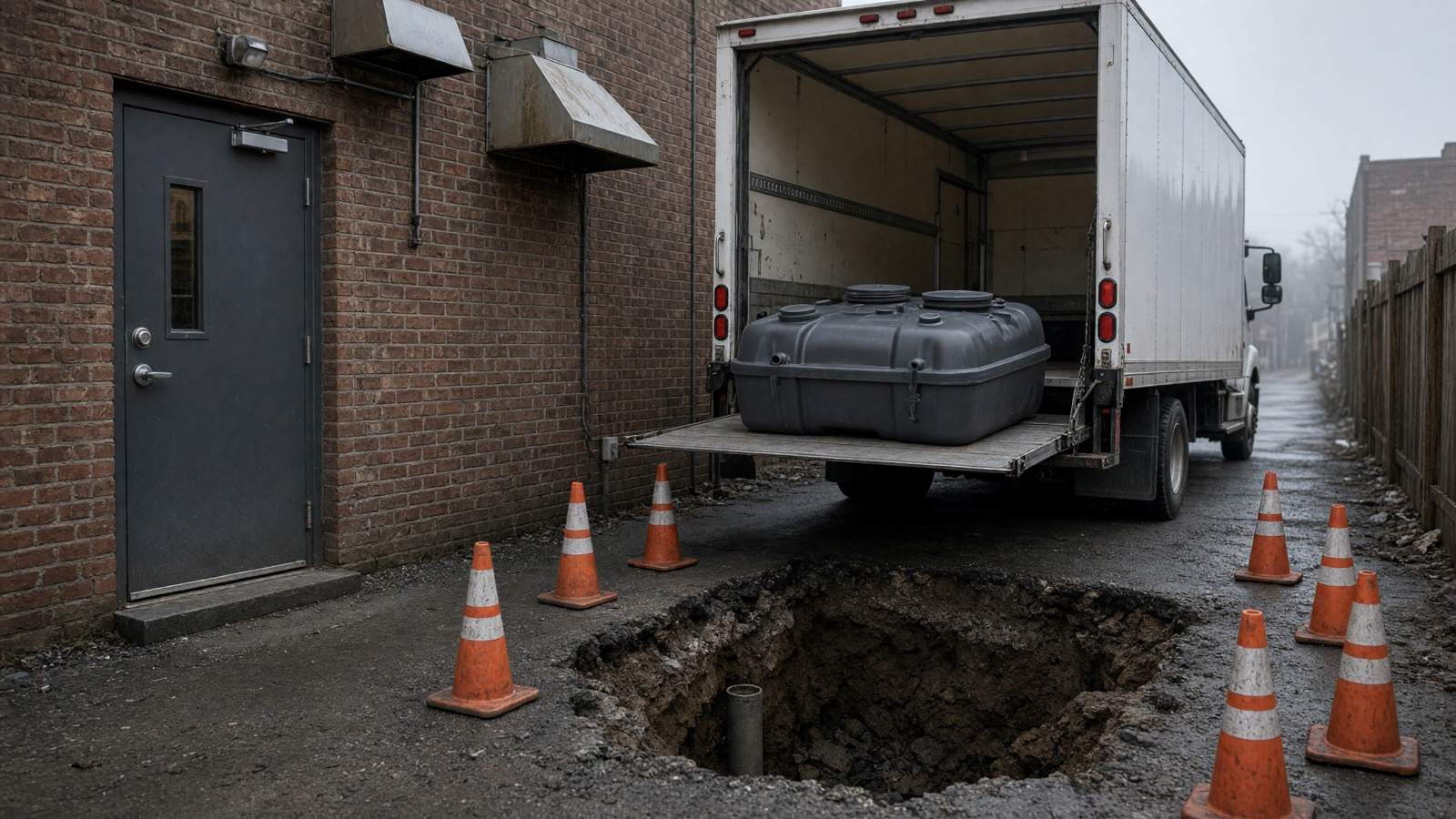
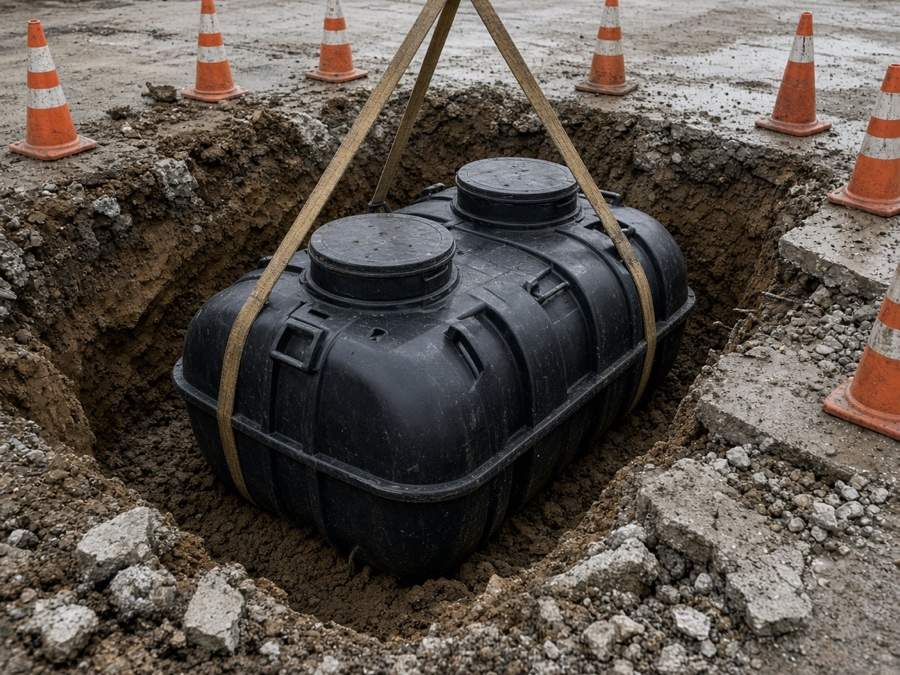
For a Fullerton kitchen that needs an exterior tank, the tank is calculated before anything is ordered. The city defines an interceptor as a vault "with a minimum capacity of between 500 and 750 gallons," built in two compartments with flow passing through a 90 degree fitting designed for grease retention. Orange County Sanitation District's regional design band runs from a 750 gallon minimum to a 1,500 gallon maximum, unless a plan checker approves otherwise. We size grease interceptor installation work off Table 1014.3.6: 8 drainage fixture units calls for a 500 gallon tank, 21 for 750, 35 for 1,000, and 172 for 1,500. An in ground grease trap of this size sits on an exterior grade slab or a parking lot strip, precast in concrete, fiberglass or heavy-duty plastic. Access manholes measure at least 24 inches across and extend to finished grade, so a pump truck can reach both compartments. The excavation and the tie-in, not the tank itself, set how long the job takes. Permit and plan check questions belong on our FOG compliance page.
Grease Trap Replacement and Capacity Upsizing
Fullerton's own inspection code doubles as the failure checklist: traps get checked for "leaking seams and pipes, and for effective operation of the baffles and flow regulating device." When we see a cracked concrete shell, a corroded steel body, or a collapsed baffle wall, that unit gets replaced rather than patched. Two regulatory triggers push a grease trap replacement that many owners never see coming. Orange County Sanitation District requires an existing food service establishment to install or upsize within 180 days if it has contributed to a sewer blockage or sits on a hotspot lateral. The same 180 day clock starts when a kitchen is "undergoing remodeling or a change in operations." Added fryers or seats move the required size in code steps rather than by estimate: Table 1014.3.6 puts 90 drainage fixture units at 1,250 gallons and 172 at 1,500. Bigger is not automatically safer, either. Oversizing can generate hydrogen sulfide gas and sulfuric acid that eat away at the interceptor and drainage system. The old unit comes out only after we pump it dry and manifest the waste for permitted disposal.
New Kitchen Build and Tenant Improvement Grease Trap Installation
California law puts commercial grease trap installation on the plan check table before a single wall goes up. Any construction or renovation of a retail food facility requires plans "drawn to scale, along with detailed specifications" submitted to the health department's Environmental Health division. The plumbing submittal has to show the interceptor sizing calculation on the isometric, not just a box on the page. On the wastewater side, a new food service establishment must have its interceptor installed before it can discharge to the sewer, and in Fullerton no establishment discharges without a FOG Wastewater Discharge Permit. That includes a retail suite converting to a restaurant, which counts as the "change in operations" that triggers the same requirement for an existing space. Sequencing matters more than most contractors expect: the rough-in gets inspected before backfill and again before final, so an interceptor set after the slab pour turns into demolition work. We coordinate directly with the general contractor to get the tank in the ground on the first pass.

Under-Sink Grease Trap Installation
An under sink grease trap is the smallest device on this page. Orange County Sanitation District is direct about when it belongs. A point-of-use trap "should only be used in those cases where the use of a grease interceptor or other grease control device is determined to be impossible or impracticable." We size these units off the sink itself. A published worked example for an 18 by 24 by 12 inch three-compartment bowl works out to 50.4 gallons of usable capacity after the loading factor. That size lands at a 50 GPM one-minute drainage rating, or 25 GPM on a two-minute period. Most indoor units with easy access run 30 to 200 gallons. Every fixture feeding the trap gets individually trapped and vented, and code requires a vent downstream of the device, not an optional add-on. One detail worth knowing before you buy: local code bars a dish machine from discharging into a grease trap.
Hydromechanical Grease Interceptor Installation
A hydromechanical grease interceptor is a rated device, not just a sized one. The governing standards are PDI G101 and ASME A112.14.3, and a unit is tested at its rated flow, so a 20 GPM model is tested with a 20 GPM flow of grease-laden water. Common market sizes run 10, 15, 20, 25, 35, 50, 75 and 100 GPM, and each carries its own minimum grease storage capacity. A 20 GPM unit holds 40 pounds, a 50 GPM unit holds 100 pounds, and a 100 GPM unit holds 200 pounds. We install these floor mounted or recessed, with a certified flow control device carrying an air intake in place of the inlet ventilation tee. An indoor hydromechanical unit can stand in for an exterior tank on a tight lot or a leased suite with no ground to excavate. That substitution is a plan checker's call on the specific site, not a product swap we make on request, and it usually comes with a shorter pump-out interval.
Automatic Grease Recovery Unit Installation
An automatic grease recovery unit separates free floating grease and oil from drain water and recovers it without a manual skim . Wastewater enters a stainless tank, a heater keeps the fat liquid, and a rotating skimming drum lifts the grease layer to a scraper blade that drops it into an external collection container while a strainer basket pulls solids out separately . Only the treated water passes on to the drain line. At the install point we run a dedicated 110VAC circuit for the skim motor and heater plus the normal inlet, outlet, and vent connections, and because these units are heavy, our crew always sets and services them with two people, never one . These certified automatic grease recovery unit installations suit high volume fryer lines where a manual trap would need daily attention, but the collection container still runs on a quarterly pump out schedule, and the manufacturer's own guidance warns that a missed pump out causes performance loss and odor . The recovered oil has to leave the site through a registered transporter rather than a floor drain.
Old Grease Trap Removal and Decommissioning
Grease trap removal starts with a full pump out, never a lift. Fullerton code defines that pump out as removing the entire content of the interceptor, including wastewater, accumulated FOG, floating material, sludge, and solids, and none of it is allowed to reach a sewer lateral, storm drain, or the right of way during the work . The load leaves with a manifest naming the hauler and the disposal site, and the property owner or operator has to keep that paperwork for at least two years . From there we decommission the old unit one of two ways: crush and fill the concrete vault in place after pumping, or extract it whole once it is empty. A crush and fill closes the tank by removing the top, filling with tamped earth to prevent settling voids, and capping or reconnecting the waste lines to the building sewer under permit . Either path ends with the kitchen waste line capped or rerouted and the surface restored, backfill, compaction, and a concrete or asphalt patch, with the scope and finish put in writing before we start.
Grease Trap Repairs We Handle: Baffles, Tees, Lids and Leaks

Baffle and Tee Repair or Replacement
A collapsed baffle wall is one of the most common grease trap baffle repair calls we get, especially in older concrete tanks. Fullerton code requires removable baffles to be pulled and cleaned during maintenance. Without a working baffle, wastewater short-circuits from the inlet tee straight to the outlet tee, and grease that should rise and stay behind goes into the lateral instead. We rebuild the wall, reset the 90 degree retention fitting, and replace tees in PVC or stainless as the tank calls for.

Lid, Riser and Access Cover Replacement
Fullerton requires access manholes at least 24 inches wide over every interceptor chamber and sanitary tee, extended to grade with covers built to keep water out. A cracked or sunken lid becomes a trip hazard and an odor complaint fast, and a lid in a drive lane needs an H-20 rating: 16,000 pounds per wheel, no safety factor. Most grease trap lid replacement jobs also add a riser, bringing a buried lid back to grade so it can be opened.
Cracked Tank and Leaking Seal Repair
A wet spot beside the lid, sewage odor outdoors, or a level that drops between services are the first signs of a grease trap leak repair call. Fullerton's inspection standard checks for leaking seams and pipes to keep devices operating efficiently. Inside an old tank, bacteria turn food-waste sulfur into hydrogen sulfide, which becomes sulfuric acid and eats concrete and steel. Often the shell is failing, not the seal. We patch with hydraulic cement or epoxy, and say when patching stops paying off.
Our Grease Trap Installation Process, Step by Step
Site Survey, Code Review and Permit Filing
Before any equipment moves, our estimator surveys the kitchen to confirm the grease trap installation requirements the job has to meet: the drainage fixture unit count for every fixture tied to the device, the tank's size and condition, the line's depth and route, and the width of the equipment access. Those numbers feed a plumbing layout and isometric plan carrying the sizing calculation a plan check reviewer expects to see . Permit filing and manifest paperwork are handled as part of the job.
Grease Trap Sizing and Flow Rate Assessment
Grease trap sizing comes off two published tables, one for each type of device. Gravity interceptors are sized off a drainage fixture unit table built on a 30 minute retention time, so a kitchen totaling 12 drainage fixture units calculates to a 750 gallon unit under Table 1014.3.6 . Hydromechanical units size off flow rate instead: a one-minute drainage period applies within 20 feet of the fixtures and a two-minute period beyond that , and connected fixture capacity may not exceed two and a half times the interceptor's certified GPM rating . Fullerton holds a kitchen to at least 500 to 750 gallons , inside OC San's 750 to 1,500 gallon band . An undersized unit is the pattern behind most early replacement calls, and oversizing is not the safe hedge it looks like, for the corrosion reason covered under replacement above.
Excavation, Tie-In and Startup Testing
We saw cut and excavate to the tank location, set the new interceptor on a bedding course, then tie the kitchen waste line to the inlet and the sewer lateral to the outlet. Backfill and a concrete or asphalt patch close the trench, followed by a water fill and flow test before the line returns to service. The work is inspected twice, at rough-in before backfill and again at plumbing final, and total time on site depends on excavation depth, site access and how quickly the inspector can turn the job around.
Why Fullerton Kitchen Operators Choose Our Installation Crew
- California C-36 plumbing licence held
- Permits filed start to finish, from plan check to final
- Sizing calculated to California Plumbing Code tables, not guesswork
- Interceptors installed from 500 to 1,500 gallons
- Own vacuum trucks for grease trap and UCO service
- Service report or manifest left after every visit
What Affects the Price of a Grease Trap Installation in Fullerton
Trap Size, Flow Rate and Fixture Count
Price sorts into three tiers: a point-of-use trap, a gravity interceptor built to a 750 to 1,500 gallon band, and a hydromechanical unit rated by GPM flow, not gallons. An Orange County price list puts a point-of-use trap install at $950 to $4,500 plus the cost of the trap itself. Fixture count sets the tier, off Table 1014.3.6's steps. See our grease trap cost guide.
Indoor Unit Versus Outdoor In-Ground Tank
An indoor unit and an outdoor tank sit far apart in cost. In Orange County, installing an indoor point-of-use grease trap runs $950 to $4,500 plus the cost of the trap itself, while a below-ground outdoor interceptor runs $15,000 to $45,000 once size and placement are factored in. The tank alone can run $5,000 to $15,000 for a large in-ground unit before shipping or installation, and installation often costs more than the tank does. Fullerton reserves interceptors for kitchens serving 500 or more meals a day, so most quotes land on the indoor side.
Excavation, Concrete Cutting and Site Access
A tank set carries cost drivers a simple swap never sees: excavation, shoring, groundwater control, backfill, risers, lids and restoration once the trench closes. A cover set in a traffic lane has to carry a 16,000-pound-per-wheel H-20 load rating, which is engineered into the price of the lid itself. When a slab cannot be saw cut safely, code allows a low profile unit above the floor instead.
Permits, Plan Check and Code Upgrades
Two gates apply: a plumbing permit for the installation, and, under Health and Safety Code 114380, a plan check of the whole food facility. Orange County's published fee schedule prices that plan check at $1,599 for a new restaurant under 2,000 square feet, $2,047 for 2,000 to 5,999 square feet, $985 for a remodel of 101 to 1,000 square feet and $1,879 for a remodel over 1,000 square feet, plus 50 percent more for expedited review. That fee is the facility's health department gate, not a grease trap permit by itself; Fullerton does not publish its own plumbing permit fee for a grease trap installation in a retrievable schedule, so budget that line item as a number your contractor confirms directly with the city. Plan checkers add a required vent, trapped fixtures, or a 24 inch access manhole, and the costliest surprise is a capacity upsize the plan checker requires.
Grease Trap Installation and Repair FAQs
Do I need a permit to install a grease trap?
Yes. Installing a grease trap requires a plumbing permit under the California Plumbing Code, since any drainage piping or fixture that is installed, altered, repaired, or replaced needs one. In Fullerton, restaurants also need a separate FOG Wastewater Discharge Permit for the discharge itself, renewed annually.
Can a plumber install a grease trap?
Yes. A licensed C-36 plumbing contractor covers the disposal of fluid waste from a building, so installing a grease trap falls within that trade and requires a plumbing permit for the work itself. Hauling away the old unit's contents needs a separate wastehauler permit, which a plumbing license does not include.
Can I install a grease trap myself?
No. California's minor work exemption lets unlicensed work up to $1,000 skip a contractor, but that exemption never applies once the job requires a permit, and installing a grease trap always requires a plumbing permit. That closes the question regardless of the project's dollar amount.
How do I know what size grease trap I need?
Grease trap sizing starts with counting the drainage fixture units on your kitchen line and reading the code table for a gravity interceptor, such as 21 DFU for a 750 gallon unit, or calculating peak flow to match a certified GPM rating for a hydromechanical unit. Fullerton's plan checker confirms the final sizing.
What is the life expectancy of a grease trap?
Manufacturers publish average lifespans of about 10 years for concrete grease interceptors and five years for steel units, but Fullerton's code measures condition, not age: a trap must stay in efficient operating condition with no leaking seams and working baffles. A well-maintained concrete vault can outlast that average.
When is a grease trap worth repairing instead of replacing?
Grease trap repair makes sense when the failure is a single part, a baffle, a tee, a lid, or a seal, and the shell itself is still sound. Replacement is the better call once the shell has failed, the unit has been outgrown, or a code trigger has fired, like a documented sewer blockage.
Get a Free Grease Trap Installation Estimate in Fullerton
Fullerton Elite Grease Trap Cleaning installs and replaces grease traps throughout Fullerton, from under-sink units in small kitchens to full in-ground interceptors for high-volume restaurants. Every estimate starts with a free on-site visit, where our crew measures your fixture count and access before quoting the installation. Call [PHONE] today to schedule yours.