Fullerton Elite Grease Trap Cleaning: Grease Trap Cleaning & Pumping Service for Restaurants & Commercial Kitchens in Fullerton, CA
Fullerton Elite Grease Trap Cleaning is the trusted grease trap cleaning and pumping company for restaurants and commercial kitchens in Fullerton, CA. Grease trap cleaning in Fullerton, CA means a full pump-out of the fats, oils and grease that build up in your kitchen's wastewater line before it reaches the city sewer system, not a quick skim off the top. Every commercial kitchen here runs against that same clock: a full trap backs up mid-rush, a FOG inspector opens a lid you forgot to schedule, or a sewage backup gets logged as a violation serious enough to suspend your permit and close your doors. We built our routes, trucks and crews around one job: grease trap pumping and grease interceptor cleaning on a schedule that holds, documented the way an inspector expects, before a slow drain turns into a shutdown. We work inside the City of Fullerton Fats, Oils and Grease Control Program on every call, so we know the permit paperwork and disposal chain your facility must keep on file. Call [PHONE] today and we will get your kitchen on a schedule that keeps inspectors satisfied and drains clear.
Get a Free Grease Trap Cleaning Quote
Trap size, access, and your preferred service window decide most of your price. Tell us your business name, kitchen address, trap size, and the window that works, and we call back within one business hour with a real number.
Why Fullerton Commercial Kitchens Choose Our Grease Trap Service
Most grease trap outfits show up with a truck and a hose. We show up as a licensed plumbing operation, because the line from your trap to the sewer lateral is plumbing work: a plumber for grease trap work catches what a general hauler walks past, a cracked baffle, a failing flow control device, a lateral pitched the wrong way. Every gallon we pull leaves through a documented chain: liquid waste pumpers in Orange County must register with the OC Health Care Agency and hold an OC San Wastehauler Permit before waste reaches the Plant No. 1 wastehauler station. We size the truck to your trap, dispatch fast, and show you where every gallon went.
Licensed, Insured & CDFA-Registered Grease Haulers
You want a licensed grease trap plumber in Fullerton, not just a vacuum truck: we hold a C-36 plumbing classification, the category built around proper disposal of fluid waste. Every truck runs with liability and pollution liability coverage. Our CDFA used cooking oil transporter registration requires a surety bond of at least $2,000,000, or $1,000,000 for a single vehicle under 10,000 pounds.

24/7 Emergency Grease Trap Service With No Kitchen Downtime
A trap that backs up mid-shift is not an inconvenience, it is an immediate health hazard, and Orange County can suspend your health permit and close the kitchen until it is fixed. We dispatch after hours when a line backs up overnight, and we send a truck during service hours the moment a trap overflows mid-rush, so dinner service keeps running instead of shutting the doors.
Documented Service Reports & FOG Manifests After Every Visit
Every visit ends with a grease trap manifest showing gallons pumped, the disposal site, who cleaned it, who witnessed it, and your next service date, the same fields the OC Health Care Agency's Grease Control Device Maintenance Record asks for. Your city FOG permit requires that paperwork on hand for two years for any inspector, so we leave it with you at every visit.
Commercial Grease Trap Cleaning & Pumping Services

Grease Trap Cleaning for Restaurants & Commercial Kitchens
Restaurant grease trap cleaning at Fullerton Elite means a full evacuation, not a surface skim. Fullerton Municipal Code 12.20.250.A defines real maintenance as removing the full content of the interceptor, wastewater, accumulated FOG, floating material, sludge and solids, not just the layer on top. Once the unit is open we inspect the inlet and outlet tees for cracks, buildup and flow restriction and confirm the baffles are still doing their job, since Fullerton code requires that check at every servicing. We hold that standard for downtown restaurants, hotel kitchens, cafeterias and campus dining halls alike: the device size changes, the cleaning standard does not.
Grease Trap Pumping & Full Pump-Outs
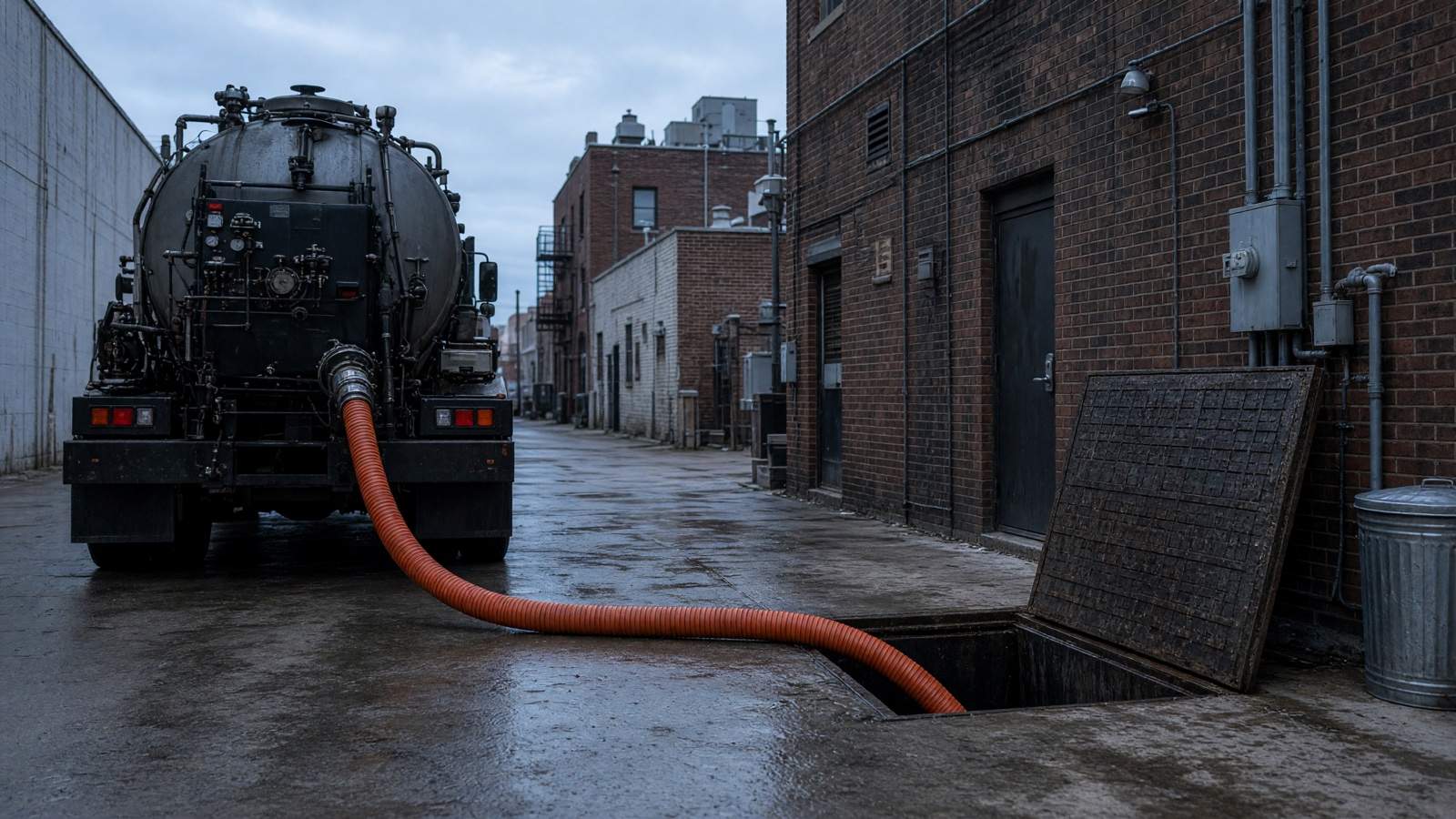
A partial skim is the single most common way a cheap vendor sets a kitchen up to fail its next inspection. Real grease trap pumping is a complete pump-out: OC San's standard states that "complete pump-out and cleaning required, surface skimming is not allowed." We pull the wastewater, FOG layer and settled sludge in one visit, no shortcuts, and haul it to OC San's Plant No. 1 wastehauler station under a valid Wastehauler Permit. We invite the kitchen manager to watch, clear proof the job got done.
Grease Interceptor Cleaning
Grease interceptor cleaning is a different job than clearing the trap under a sink. Fullerton's own code defines the interceptor as a vault set outside the building holding a minimum of 500 to 750 gallons, with two compartments connected by a 90 degree fitting built for grease retention. Orange County's regional design band runs from 750 up to 1,500 gallons, inlet chamber sized for roughly two thirds of capacity. Servicing one means manhole access instead of a cabinet door, with both chambers pumped and inspected.
Indoor & Under-Sink Grease Interceptor Cleaning
Indoor grease interceptor cleaning covers the small hydromechanical units set under three-compartment sinks and beside dish machines, point-of-fixture devices used only where a full interceptor isn't practical. Servicing one means working inside a live kitchen: we move equipment, protect the floor, pull and clean the removable baffle, then reset and test the unit. The smell that spikes when we open the lid is hydrogen sulfide, released by agitation, and we contain it rather than let it drift into the dining room.

Outdoor & In-Ground Grease Interceptor Cleaning
Outdoor grease interceptor cleaning is a different job site: a concrete or heavy-duty plastic vault set underground in a parking lot or alley, reached through access manholes Fullerton code sets at a minimum 24 inch diameter with covers that lift clean and reseat gasketed. We treat every entry as a permit-required confined space under Cal/OSHA 8 CCR 5157, testing the atmosphere for oxygen, flammable gas and hydrogen sulfide first, and most services finish without entry at all. We schedule these jobs after hours so the lot stays open.
Grease Trap Odor Control & Deodorizing
That rotten-egg smell is hydrogen sulfide, produced when bacteria feed on the trace sulfur naturally present in kitchen food waste. Agitation or a temperature spike releases it from the liquid, which is why the odor peaks right after a busy shift. A grease trap deodorizer only masks that gas; it does not remove the sulfur source in the unit. Fullerton also restricts biological additives without written authorization from the FOG Control Program Manager, so we treat odor as a signal to schedule a pump-out, not a chemical problem to dose around.
Grease Trap Installation, Repair & Replacement

New Grease Trap & Interceptor Installation
Every new grease trap installation starts with sizing to fixture units and peak flow rate, the standard Fullerton requires under the California Plumbing Code. A limited-menu kitchen typically takes an indoor hydromechanical trap; a full-menu operation running 16 hours a day or serving 500 or more meals needs an in-ground gravity interceptor of at least 750 gallons across two compartments. Every job needs a plumbing permit before we open a trench, which we pull before work starts.
Grease Trap Replacement & Upsizing
Cracked concrete, corroded steel and seams that no longer seal push us toward replacement. A regulatory trigger forces the same decision: a facility tied to a sewer blockage or a hotspot lateral must install a new interceptor within 180 days of notice, as must one undergoing a remodel or a change in operations. Adding fryers or seats counts as a change in operations, which is when we upsize rather than reinstall the same unit. A baffle that no longer functions tells us a trap is past saving.
Grease Trap Repair
Most repair calls come down to four failures: a leaking seam, a cracked wall, a failed gasket, or a seized cleanout. Fullerton code requires every trap to stay in efficient operating condition and easily accessible for inspection, with manholes built for removable covers rather than covers we have to pry open. We carry gaskets, cleanout hardware, and baffle fittings on the truck, so most repairs close out same-day and your kitchen keeps its shift. A device that lets sewage reach the floor is a violation Orange County treats as an emergency, permit suspension included.

Baffle & Tee Replacement
A baffle's only job is to hold wastewater long enough for grease to congeal and rise, before clear water beneath the FOG layer moves toward the sewer lateral. A cracked or missing baffle lets wastewater short-circuit from inlet tee to outlet tee, so grease that should have separated rides into the lateral instead. Fullerton code requires baffles be inspected for effective operation and cleaned during service. That is why a collapsed baffle gets written up, and why our grease trap baffle repair replaces the tee too.
Grease Trap Lid & Manhole Cover Replacement
A cracked or ungasketed lid lets odor out and storm water in, which is why Fullerton code requires covers designed to prevent water inflow. A settled or brittle lid is also a trip hazard, so grease trap lid replacement here means a gasketed, 24 inch cover fitted to the manhole, not a patch. A cover in a drive lane or lot where a food truck parks needs an H-20 traffic rating, built for 16,000 pounds per wheel.

Grease Line Hydro Jetting & Kitchen Drain Cleaning
Grease Line Hydro Jetting
We hydro jet the sewer lateral between the trap and the main to cut through hardened grease scale, left when wash water above 140 degrees Fahrenheit dissolves grease that resolidifies as it cools. On a typical 4 to 8 inch commercial line we run 10 to 12 GPM at 4,000 PSI; pushing higher risks cracking older clay or Orangeburg pipe. Nozzle choice changes with pipe diameter, material and condition. We finish every job with a camera pass so you see the line clean before we call it done.
Kitchen Drain Hydro Jetting & Line Cleaning
Kitchen lines foul fastest at pot-washing sinks, pre-rinse stations, floor drains and dish machine runs, not the fryer most owners suspect. A cable bores one channel through a blockage; jetting scours the full pipe wall instead, since it's flow rate, not pressure, that carries the film out. On these smaller 2 to 4 inch runs we jet at 8 to 10 GPM and 3,500 to 4,000 PSI. We also fit drain screens on every sink and floor drain we clear, a required practice that keeps the line clear between visits.
Clogged, Backed-Up & Overflowing Grease Traps
We get the same call every week: a grease trap overflowing in the middle of dinner service. We run one diagnostic, is it simply full, is the outlet tee blocked, or has the lateral beyond it failed, since the fix differs for each. Standing FOG on a kitchen floor is an immediate health hazard in Orange County, and it can get a health permit suspended until it is cleaned and repaired. That is why we dispatch mid-shift and after hours: stop the source, contain the spill, then pump the trap down.
Grease Spill Cleanup & Containment
Grease trap spill cleanup starts with absorbent material, never a hose, since Fullerton code bars letting FOG reach a sewer lateral, storm drain or public right of way during maintenance. We protect the nearest storm drain inlet before touching the interceptor, because an uncontained spill runs down the lot and out through the storm system as raw sewage. Once the area is clean, we handle the paperwork: Fullerton requires immediate notice to the City, then written confirmation of the cause and corrective steps within five working days.

Used Cooking Oil Collection & Recycling Service
Used Cooking Oil Collection
We set indoor tanks near the fryer line and outdoor tanks at the loading dock, sized to fryer count and change-out frequency. Fullerton requires waste cooking oil to stay out of drainage pipes and be collected in barrels, drums or a dedicated tank for recycling, a minimum best-management practice for every food establishment in the city. We install locked containers as standard, since cooking oil theft is on the rise. Every gallon moves on a CDFA-registered vehicle, the only kind California law allows to haul inedible kitchen grease off your property.
Scheduled Used Cooking Oil Pickup
We set your route frequency by how fast your kitchen fills the tank, not a fixed calendar date, and add on-call pickups when a catering week or a holiday rush runs the fryer harder than normal. A missed pickup does not stay a scheduling problem: a full container becomes an overflow, and Fullerton treats spilled or drained cooking oil as a code violation. Every pickup gets logged the way the City's own Recyclable Grease Disposal Log expects.
Used Cooking Oil Recycling & Biodiesel Diversion
Your oil does not disappear once it leaves the tank. It is tested for contaminants, settled to remove solids, heated under vacuum to strip impurities, then sold as processed material for reuse. From there it becomes biodiesel, animal feed, soaps, or other industrial products, the same outcomes state law names when it authorizes a registered transporter to deliver kitchen grease to a licensed renderer or collection center. For a tenant that needs to prove diversion, we keep the two years of collection site, quantity and date records California requires of a CDFA-registered hauler.
We Buy Used Cooking Oil: Rebates for High-Volume Kitchens
If you want to sell used cooking oil rather than pay to have it hauled, it depends on quality and volume: the value moves with the commodity market renderers track, not a flat rate we set. For most kitchens we run free collection with no fee either direction; for a clean, high-volume stream we discuss a rebate. Before you sign with anyone, ask: is there a fee or a payment, where does the grease go, and what counts as contamination.

FOG Compliance, Inspections & Grease Trap Maintenance Plans
Grease Trap Inspections & Compliance Checks
Every grease trap inspection we run starts with a core sample, not a guess: we lower a sludge judge through the access port, valve it shut, and read the FOG layer against the solids below. Fullerton Municipal Code 12.20.250.E.1 sets the line, your interceptor must be pumped before combined FOG and solids exceed 25 percent of total liquid depth. A failed check can raise your mandated frequency, and FOG compliance in Fullerton is enforced through fees, permit suspension and revocation.
Grease Trap Maintenance Plans & Route Service
We build every grease trap maintenance plan around measured sludge height, not a calendar guess. Fullerton's code sets the interval in order of preference: a frequency that keeps the trap under that 25 percent line, never less often than every six months, quarterly by default. We log sludge height at every route stop, and that record supports a request to the FOG Control Program Manager to revise your permit frequency. Once your route is set, dispatch and pricing are locked to the contract.
Service Manifests, Cleaning Logs & Inspection Records
Every cleaning generates a grease trap cleaning log entry the same day, on paper in your on-site binder and as a digital service report. Fullerton requires you to keep every manifest, receipt and invoice tied to cleaning and disposal for no less than two years, available on request to any city inspector. Our reports carry the fields a county inspector asks for, date, cleaned by, witnessed by, gallons pumped and disposal site, and every manifest lines up with OC San waste discharge permit documentation.
Fullerton Grease Trap Permit & FOG Program Support
A grease trap permit in Fullerton comes first: no food service establishment may discharge kitchen wastewater to the sewer without a FOG Wastewater Discharge Permit under the city's FOG Control Program. It runs no more than one year, must be renewed, and does not transfer with a sale, so new ownership means a fresh application. We service to the frequency your permit specifies and hold the OC San Wastehauler Permit that lets us legally take your grease to the county station.
Our Grease Trap Cleaning Process, Step by Step
Scheduling & On-Site Assessment
A quick call or form gets us your trap type, gallon capacity, kitchen hours, access route, and last service date. Before quoting we check lid access and truck parking. You get a realistic scheduling window, not a vague callback promise.
Full Evacuation, Scraping & Line Check
We pump out everything, water included, not just the floating fat. Next we scrape caked-on grease off the walls, pull the removable baffles, and check the inlet and outlet tees and the line beyond before resealing the lid. In-ground units get atmospheric testing first.
How Long Does a Grease Trap Cleaning Take?
A small under-sink trap on a regular schedule takes about 20 minutes. A full visit generally runs 45 minutes to a few hours , in-ground interceptors at the longer end. Two things stretch it: hardened FOG in a lapsed trap, or a buried, bolted lid.
What Your Kitchen Staff Needs to Do Before We Arrive
Stop running your three-compartment sink and dish machine about an hour before we arrive, so grease can settle. Clear the trap lid and keep the access route open. Have someone on site to sign the manifest. Your dish machine must never drain into the trap.
Manifest, Service Report & Your Next Service Date
Before the truck leaves, you get a manifest and photo report: date, cleaned by, witnessed by, gallons pumped, disposal site. Keep both two years, per Fullerton code. Your next service date is set by trap size and fryer load, not a guess.
How Much Does Grease Trap Cleaning Cost in Fullerton?
Grease trap cleaning cost runs $115 to $475 per visit for an indoor trap and $325 to $1,040 for an outdoor interceptor; a lapsed trap can run three times that. Full pricing by size: our cost guide.
Grease Trap Cleaning Cost by Trap Size
Small indoor traps (30 to 200 gallons) run $125 to $180 scheduled, or $190 to $240 one-off. Large in-ground interceptors, 500 gallons and up, run $225 to $900 per service. New installation starts around $250 for a small under-sink unit and reaches $4,000 to $8,500 for a large interceptor. Full breakdowns: cost guide.
Grease Trap Pumping Cost
Per-visit pumping runs $115 to $1,040 depending on trap size and condition. Some haulers price by the gallon, with published contracts showing $0.20 to $0.84 per gallon for waste removal. On a small trap, per-gallon pricing can beat a flat rate. Full breakdown: our cost guide.
What Changes Your Price (Trap Size, Access, Service Interval, After-Hours Calls)
Trap size raises the price most; a buried interceptor lid in a live parking lot costs more to reach than an under-sink unit; a lapsed service interval costs more than a routine route; and after-hours or weekend calls price above routine daytime service.
What Fullerton Restaurant Owners Say About Our Grease Trap Service
Restaurant owners and kitchen managers who work with us know what to expect: a crew that shows up on schedule, a full pump-out instead of a skim, and a signed manifest and service report left behind at every visit, so nothing about the job is a surprise at your next inspection. We are happy to connect you with references from current Fullerton-area clients on request, before you book.

Proudly Serving Fullerton and Nearby Orange County Cities
Our home base is Fullerton, and we run routes across the commercial kitchens of Anaheim, Buena Park, Brea, Placentia, La Habra, Orange, Santa Ana, Garden Grove, Westminster, and Tustin. We work a roughly 15 mile radius, weighted by commercial kitchen density, not raw distance. Downtown Fullerton's Harbor Boulevard corridor counts more than 70 historic buildings and 2,500 public parking spaces. Add Fourth Street in Santa Ana, Little Saigon across Westminster and Garden Grove, and Old Towne Orange: if you are searching for grease trap cleaning near me along the 91, 5, or 57, we are already on that route.
Grease Trap Cleaning FAQs
How much does it cost to have a grease trap cleaned?
A serviced indoor grease trap runs $115 to $475 per pump-out, and an outdoor interceptor runs $325 to $1,040. Waiting past due can push the price three times higher. Our cost guide breaks pricing down by trap size.
How often should a grease trap be cleaned out?
Fullerton's FOG Control Program defaults to quarterly cleaning. But the real trigger is the 25 percent rule: once FOG and solids reach a quarter of the trap's depth, it needs pumping.
Can I clean a grease trap myself?
Yes, day-to-day upkeep, scraping and skimming grease, is the kitchen's job. But the full pump-out isn't DIY: removed grease must go through a permitted hauler and produce a manifest kept on file for two years.
Do plumbers clean grease traps?
Yes, but it's two different permissions: our C-36 plumbing license covers line work, while pumping and hauling the contents needs a separate wastehauler permit from OC San. That's why the county sends kitchens to a hauler, not a plumber.
What kills the smell of a grease trap?
The smell is hydrogen sulfide, released when bacteria break down grease and its sulfur content. The fix is a full evacuation and a sealed lid, not an enzyme product: Fullerton restricts biological additives without written authorization.
Is there a difference between a grease trap and a grease interceptor?
Yes. A trap is a small indoor reservoir with baffles that let grease rise, while an interceptor is an exterior vault of 500 to 750 gallons. Fullerton schedules them differently: interceptors follow the 25 percent rule.
Do you legally have to have a grease trap?
Yes, in most cases. Fullerton bars any food service establishment from discharging kitchen wastewater without a FOG Wastewater Discharge Permit, and its FOG Control Program decides whether that means a trap or an interceptor. Reheat-only kitchens are exempt.
What happens if you don't clean grease traps?
An ignored trap backs up first, flooding the kitchen's lowest sink. Anaerobic bacteria then release hydrogen sulfide, smelled at 2 parts per million. Past 25 percent Fullerton can mandate service or suspend the permit.
Book Grease Trap Cleaning in Fullerton Today
Talk to a Grease Trap Expert right now at [PHONE] and get 24/7 emergency service for your Fullerton facility. Or request a free quote through our online estimate form and we will schedule your grease trap cleaning the same day, seven days a week.