Grease Line Hydro Jetting and Kitchen Drain Cleaning in Fullerton, CA
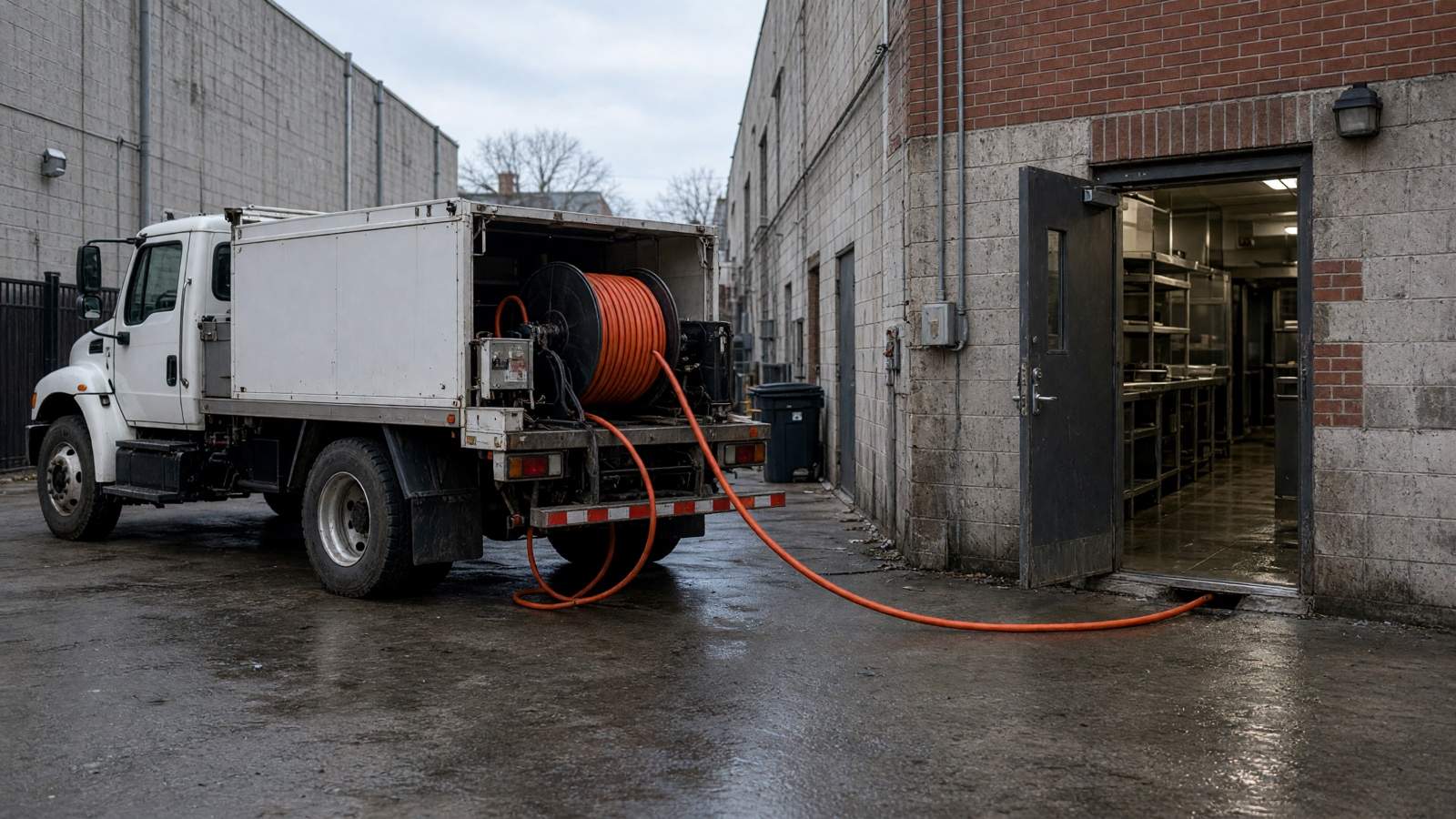
Fullerton Elite Grease Trap Cleaning runs grease line hydro jetting for commercial kitchens where the line between the three compartment sink and the sewer lateral has hardened into scale rather than a simple clog. Grease that leaves the kitchen hot dissolves into the wash water, then resolidifies on the pipe wall as the water cools inside the line. Cabling only punches a channel through that buildup and leaves the scale coating the walls, which is why the backup returns days later. Our jetter works the full 3,500 to 4,000 PSI band at 10 to 12 GPM on a 4 to 8 inch commercial line, carrying 500 feet of hose to reach cleanouts set back from the building.
The city's own Fats, Oils and Grease Control Program sits under Public Works, Environmental Services, alongside OC San's regional program, under which the city owns and maintains the small sewers a restaurant ties into. Interceptor sizing follows the California Plumbing Code, 2025 edition, in force since January 1, 2026, per Fullerton Municipal Code 12.20.210.B. We hold a C-36 plumbing classification covering the proper disposal of fluid waste from the premises. We take after-hours calls for a kitchen sink or floor drain that backs up mid service.
Get a Free Grease Trap Cleaning Quote
Trap size, access, and your preferred service window decide most of your price. Tell us your business name, kitchen address, trap size, and the window that works, and we call back within one business hour with a real number.
Grease Line and Drain Jetting Services We Handle in Fullerton

Grease Line Jetting From the Trap to the Sewer Lateral
We run this hydro jetting pass from the outlet tee of your grease trap or interceptor, through the building lateral, to the city sewer connection. On a 4 to 6 inch grease line we hold a working pressure between 3,500 and 4,000 PSI at a floor of 8 GPM, moving up to 10 to 12 GPM on wider 4 to 8 inch commercial runs. We stay under 4,000 PSI even on a heavy line, since pushing past that band risks damaging older clay or Orangeburg pipe without cutting any faster. The head on this pass is a rotating nozzle, not a cable: it scours the full circumference of the pipe wall as it spins down the line, where a cable only bores a channel through the deposit and leaves the rest coated. That matters on a grease line, where a cable's narrow channel leaves the rest of the wall coated and ready to close back in. Fullerton defines the device this run starts at as a vault of at least 500 to 750 gallons with a minimum of two compartments, so the outlet tee is a fixed point on every job.
Kitchen Sink and Three Compartment Sink Drain Jetting
The branch lines feeding your three compartment sink and hand sink are where emulsified fats cool and set first, long before they reach the trap. Code sizes that branch at a minimum two inch diameter drain line, run from the sink's trap arm to a cleanout. We work that 2 inch branch with a small diameter nozzle sized to fit it, fed through the cleanout or the trap arm, at 8 to 10 GPM and 3,500 to 4,000 PSI, enough flow and cutting force for a line that size without overworking it. Hot water and enzyme pours will not fix a branch like this. Wastewater over 140 degrees F just dissolves the grease so it resolidifies further down the line once it cools, moving the problem rather than removing it. In Fullerton that shortcut is not even an option: Fullerton Municipal Code prohibits discharging wastewater over 140 degrees F to a grease control device, and it separately prohibits enzyme or bacterial additives for grease remediation without prior written authorization from the FOG Control Program Manager. This branch is where kitchen drain cleaning has to start: jetting it clears the scale itself instead of relocating it downstream.

Kitchen Floor Drain and Trench Drain Jetting
Floor drains and trench drains under the cookline and dish pit take on a different mix than a sink branch does: grease, food solids, and mop water together, since the agency that regulates food service discharges names pot-washing sinks, pre-rinse stations, and floor drains near soup kettles as major sources of that combined load. Floor drain jetting here starts by pulling the grate, then running the jetter with enough flow to carry the trapped solids forward toward the trap rather than repacking them further down the line. Standing water at a floor drain is usually the first visible symptom you get, and it is often a sign that the real blockage sits further down the branch rather than at the drain itself. Once the line is clear, we reset the drain screen, which is not optional in Fullerton. It is a written Best Management Practice the city requires on kitchen floor drains and floor sinks.
Dish Machine, Prep Sink and Mop Sink Line Jetting
These three branches carry three different loads, and commercial kitchen drain cleaning here follows a set order rather than one pass at random. Dish machine discharge runs hot and carries detergent, and by code it is not even allowed to run through your grease trap or interceptor: Fullerton Municipal Code requires it to bypass the device entirely, so whatever grease that hot, detergent-carrying water picks up goes straight into the line and sets up downstream instead. Prep sink lines carry starch and produce trim instead of grease, and mop sinks carry whatever grease got wiped off the kitchen floor. We jet from the furthest fixture back toward the trap, one branch at a time, so everything gets flushed to the device built to catch it instead of getting pushed past it toward the building or the street. That sequence is our practice on every job, not a code requirement, but it follows the same principle the agency states plainly: FOG has to end up at the interceptor, not downstream of it.
Main Sewer Lateral Jetting for Commercial Kitchens
The building lateral is the 4 to 6 inch run from your last cleanout to the city sewer main, and it backs up an entire kitchen at once when it clogs, not just one fixture. This sewer jetting service calls for a trailer or truck mounted rig rather than a portable cart unit, which cannot move the volume of water a line this size needs. That flow matters, since a minimum of 8 GPM is what it takes to clear a 4 to 6 inch grease line effectively. Jetting clears soft blockages such as grease and sludge, but it exposes two problems it cannot fix: root intrusion, where roots have grown in through a separated joint, and a bellied section, a low spot where solids collect instead of draining through. When the camera shows either one, we document it and hand the finding to a repair scope rather than pushing pressure at a problem pressure cannot solve.
Overflowing and Backed Up Trap Line Rescue Jetting
When a grease trap overflowing onto the kitchen floor interrupts service, we do not start with the tank. We shut off the fixtures that are still sending water and grease downstream, then pump the standing volume out of the interceptor with a vacuum truck so nothing else backs up while we work. From there we jet the outlet line, since a trap that is already full and now overflowing almost always means the blockage sits downstream of the tank, not inside it. Once the line is open we run a camera back through it to confirm full flow before we leave. Orange County Health Care Agency treats a sewage backup inside or outside a food facility as an immediate health hazard, one that puts the health permit at risk of suspension and the facility at risk of a temporary closure. Where several restaurants share one lateral, a spill outside the building can suspend every permit tied to that line. We answer our line day and night, including weekends, because a kitchen cannot hold service with grease backing up onto the floor.
Hardened Grease Scale and Clogged Line Cutting
A clogged grease trap rarely starts as soft grease. Free fatty acids in the waste stream react with calcium already present in the collection system and set as a calcium soap, a hardened rind bonded straight to the pipe wall rather than something that simply washes away. Laboratory analysis of the deposits found the same calcium-based fatty acid salts building up in sewer lines generally, and those deposits are a documented driver of sewer overflows and the fines and repairs that follow. A cable can punch a channel through that rind and buy a kitchen a few weeks before the line narrows back down. Jetting works differently: we run a penetrating nozzle first to open the line, then follow with a rotating nozzle and hot water that scours the wall back out to its full bore, since higher pressure cuts through hardened grease and higher flow is what actually carries the debris out of the pipe.
Grease Spill Response and Wash Down Containment
A grease spill around an outdoor interceptor lid in an alley or parking lot gets contained, not hosed down. We lay absorbent booms and socks around the spill and the nearest storm drain inlet first, since Fullerton's code bars any FOG from an interceptor from passing into a sewer lateral, storm drain, or public right of way during maintenance. Orange County Health Care Agency gives the same instruction to facilities: soak up a grease spill, never flush it down the drain. We vacuum the recovered grease rather than washing it toward the drain, then finish with a degreaser wash down of the pad. Grease trap spill cleanup on a shared lot also carries a reporting duty: immediate telephone notice to the City, immediate notice to the county health department where the discharge could cause a blockage or a sewer overflow, and written confirmation to the FOG Control Program Manager within five working days, filed on the City's Certified Spill Report form.
Our Grease Line Jetting Process, Step by Step

Camera Inspection and Line Locating
Before the jetter goes in, we run a camera down the cleanout: scale thickness, an offset joint, root intrusion, or standing water in a bellied section. A sonde in the camera head sends a signal at 512 Hz that we trace from the surface, marking depth and position within a practical range of about 10 to 20 feet. That sewer camera inspection also confirms the pipe can safely take high pressure.
Jetting the Line and Cutting the Grease Scale
We feed the hose to the far end and work it back, so every pass flushes debris toward the trap, not deeper into the building. Passes repeat until return water runs clear, not a fixed count. Fullerton code bars any FOG removed during maintenance from passing into a sewer lateral, sewer system, storm drain, or public right of way. Recovered solids stay at the trap, never pushed toward the city main. That is drain jetting done right.
Post Jetting Verification and Service Report
Once the line is clear, we run a second camera pass to confirm the pipe is clean end to end, plus a flow test at the fixtures. Every visit ends with a dated written report and before and after footage, real restaurant drain maintenance records an inspector can check. Fullerton requires that record for two years, available to the City or an OC Health Care Agency inspector. Manifest details live on our FOG compliance and inspections page.
Jetting Equipment and Nozzles We Use
Trailer and Truck Mounted Jetters, Pressure and Flow Ratings
Our hydro jetting equipment is matched to the job. Portable and cart jetters run 2,000 to 3,000 PSI at 2 to 4 GPM, fine for a kitchen branch but light for a busy lateral. A trailer or truck mounted jetter carries the range this work usually needs, up to 4,000 PSI at 12 to 18 GPM, with roughly 500 feet of hose on the reel. Flow moves the debris; pressure cuts it loose.

Nozzle Types for Grease, Roots and Solids
We choose hydro jetting nozzles by function. A penetrating or forward jet nozzle punches through a hard stoppage, grease plugs or scale, to open the line. Then a rotating or spinner nozzle scours the wall 360 degrees back to bare pipe. A flat chisel head knocks down a grease ring, and a rotary head takes on a heavy lateral. A grease line normally takes the penetrator first, then the rotating head, sized to the line.
Why Fullerton Restaurants Choose Us for Grease Line Jetting
- Fullerton Elite Grease Trap Cleaning holds a California C-36 plumbing classification
- Commercial jetter rated 3,500 to 4,000 PSI, 10 to 12 GPM
- Camera verification on every jetting job, before and after
- 24/7 emergency line answered for after-hours grease line backups
- Written, dated service report and manifest left after every completed visit
What Grease Line Hydro Jetting Costs in Fullerton
Line Length, Diameter and Cleanout Access
A two inch branch reached through an existing cleanout is the cheap end. A six inch lateral with no cleanout, reached through a pulled toilet or roof vent, is the expensive end. An Orange County price guide publishes restaurant kitchen jetting at $900 to $2,500 or more. Our cost guide covers the full range.
How Hardened the Grease Buildup Is
A line on a route typically takes one pass. A line never jetted needs several passes and a second nozzle, penetrator first, then rotating head, and that is the single biggest swing in the quote. Neglect can push the price up to three times a routine visit in Orange County. Neglect, not the jetter, is what moves a quote to the top of the published range.
After Hours, Weekend and Same Day Response
We answer the emergency line anytime; billing depends on when we come out. An Orange County price guide lists an after hours premium of $150 to $400. A second Orange County guide corroborates the structure, at $100 to $300 added, or a 50% to 100% surcharge at companies that charge one instead of a flat add. The mechanism behind that premium is local too: OC San itself bills a permitted hauler $102.00 for a prearranged after-hours discharge and $165.00 for an emergency one at the disposal station. A Saturday dinner service callout costs more than a scheduled weekday morning visit, since a service backup can suspend a permit.
One Time Call Versus a Scheduled Jetting Route
A one time reactive call costs more than a visit bundled onto your service stop. A jetter manufacturer recommends monthly jetting for a high volume fryer kitchen, closer to every two weeks at the busiest ones. An Orange County price guide lists restaurants at 6 to 12 months. That schedule sits apart from the quarterly pump out Fullerton requires.
Grease Line Hydro Jetting FAQs
How long does hydro jetting take?
Most jetting visits finish in two hours or less; a branch line is quicker, a full lateral with a camera pass longer. How long hydro jetting lasts afterward depends on fryer volume, from about 6 to 12 months for a typical restaurant down to monthly for a busy fryer kitchen.
Is hydrojetting bad for pipes?
No, not when the line is camera checked first and pressure matches the pipe. The risk sits above 4,000 PSI, rarely needed and more likely to damage older clay or Orangeburg pipe. That is the hydro jetting vs snaking difference: jetting scours the full wall while a cable only bores through the clog.
Why does my grease trap keep overflowing?
A grease trap backing up almost always means the outlet line is blocked. It can also mean the trap passed the 25 percent rule, where grease and solids exceed a quarter of the liquid depth. Pumping the tank without jetting the line is why it returns.
How to clear a blocked grease trap?
Stop using the fixtures and contain the spill first. Then the tank needs a complete pump-out, since surface skimming alone is not allowed, followed by jetting the outlet line and a camera check. The material removed must go to a licensed hauler and a permitted disposal point.
What are the signs that my grease trap is leaking?
A grease trap leaking usually starts at the inlet or outlet tee, the baffles, the lid gasket, or a tank seam. Watch for wet ground near the lid, odor between services, or a water level that will not hold. We cover that repair on our installation and repair page.
How often should commercial drains be cleaned?
Commercial drain cleaning in Fullerton follows a quarterly default for the trap itself, required at least every 90 days and never less than twice a year. Kitchen drain lines are jetted on that same cycle or more often, since a high-volume fryer kitchen can push line jetting to monthly.
Get a Free Grease Line Jetting Estimate in Fullerton
Fullerton Elite Grease Trap Cleaning provides grease line hydro jetting service for restaurant kitchens and commercial drains throughout Fullerton, from a single blocked branch line to a full lateral jetting with camera verification. Every estimate is written free, with no obligation attached. Call [PHONE] today to schedule your free grease line jetting estimate.