Grease Interceptor Cleaning in Brea, CA
Grease interceptor cleaning in Brea looks different than it does in a lot of neighboring kitchens, because the city's two big commercial food clusters, the Brea Mall food court and the restaurants along Birch Street and Brea Boulevard, mostly run large in-ground interceptors instead of the small under-sink traps you would find behind a strip-mall counter. That distinction changes almost everything about the job: access, equipment, scheduling, and what a real cleaning actually involves. Fullerton Elite Grease Trap Cleaning services both device types out of our Fullerton shop, a short drive away, and this page covers what interceptor service looks like for a kitchen here specifically. Our overview of outdoor and in-ground grease interceptor cleaning covers the full range we handle, from small indoor units to buried vaults, at every kitchen we serve.
Whether your kitchen sits inside the mall, in one of the Birch Street restaurant spaces, or somewhere else in Brea, the device you have usually comes down to how much your kitchen produces and how the building was plumbed when it went in. Interceptors are the larger, exterior units built for volume. Smaller Brea kitchens still run indoor traps, and we service both, but this page stays on the interceptor side of that line.


Get a Free Grease Trap Cleaning Quote
Trap size, access, and your preferred service window decide most of your price. Tell us your business name, kitchen address, trap size, and the window that works, and we call back within one business hour with a real number.
Why Brea Mall and Downtown Brea Kitchens Run In-Ground Interceptors, Not Small Traps
Brea incorporated on February 23, 1917, as the eighth official city of Orange County, and the city's commercial identity took shape in two distinct waves. The opening of the Orange Freeway and Brea Mall in the 1970s drove the first wave of growth, and a mall food court is exactly the kind of high-volume operation a small under-sink trap was never built to handle. A grease interceptor is a multi-compartment vault, generally installed underground between the kitchen and the sewer connection, built for that scale of use. A trap is a much smaller point-of-fixture device meant to serve one or two fixtures, used only where a full interceptor is not practical.
Downtown Brea is the second driver. In the late 1990s, a fifty-acre swath of downtown centered on Brea Boulevard and Birch Street was redeveloped into a shopping and entertainment district that opened with movie theaters, sidewalk cafes, a comedy club, and a weekly farmer's market. Sidewalk cafes and sit-down restaurants in a district built like that skew toward the same higher-volume category as the mall, which is why our route through here runs mostly interceptor work rather than the trap-heavy mix we see in some other cities nearby. The city sits at the northeastern edge of Orange County's business corridors, bordering La Habra to the west and Placentia to the south, a stretch of the county line our Fullerton-based crew already covers on the same route day.
What Cleaning a Large, Multi-Compartment Interceptor Involves
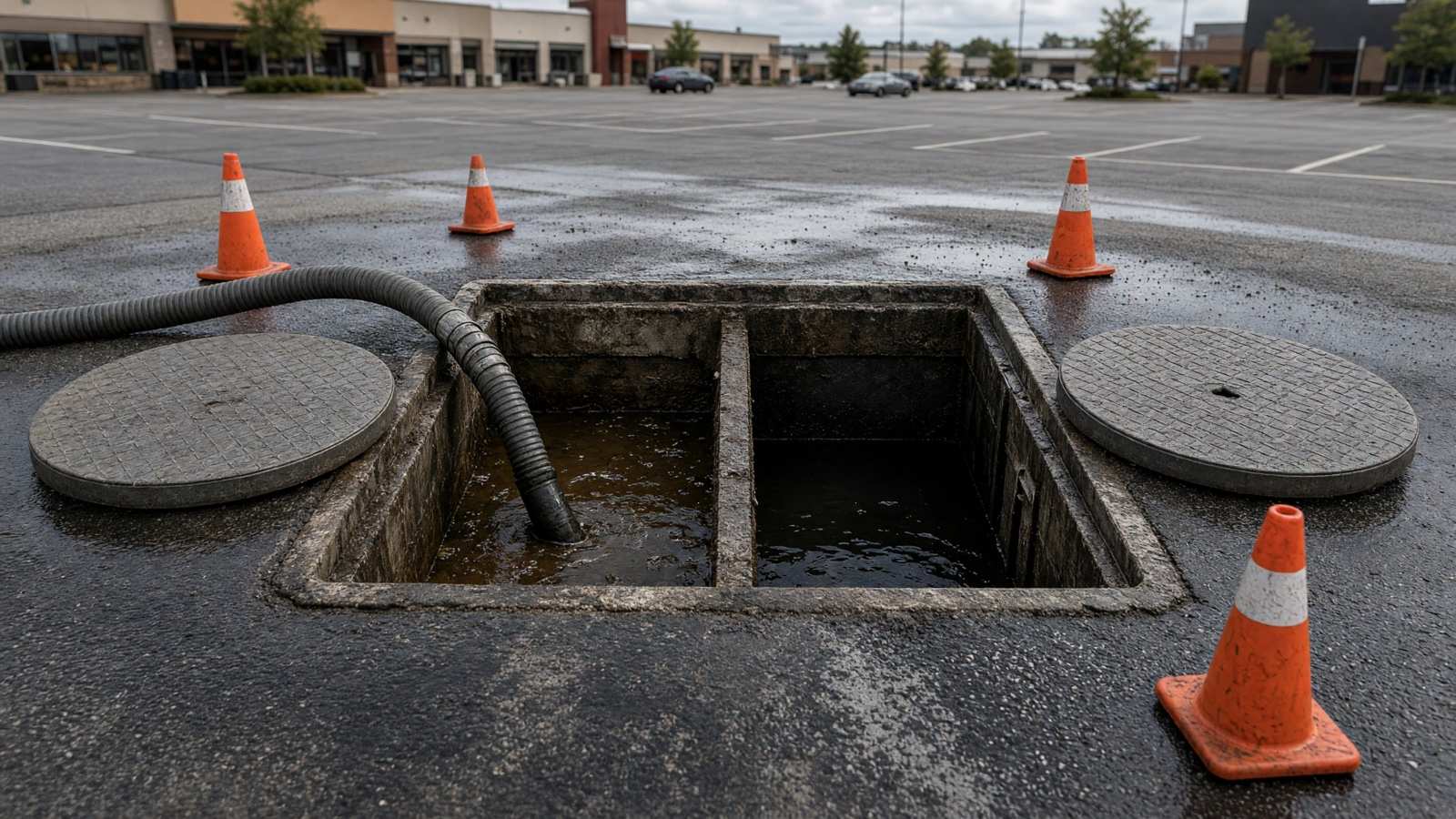
Servicing a Brea interceptor is a different job than servicing a small trap, and the difference starts with what is inside it. A grease interceptor built to Orange County's regional sizing guideline runs between 750 and 1,500 gallons, split roughly two-thirds inlet compartment and one-third outlet compartment, with flow between chambers moving through a fitting designed specifically for grease retention rather than a plain pipe. Every gallon of that capacity has to come out, not just the floating grease layer on top. Regional guidance is explicit that a complete pump-out and cleaning is required and that surface skimming is not an acceptable substitute. We pump the full contents, scrape the walls and baffles clean of caked-on residue, and inspect the inlet and outlet fittings before anything goes back together.
Access is the other big difference from a trap under a sink. An in-ground interceptor here is reached through access manholes rather than a cabinet door, generally sized at a minimum 24-inch diameter and set at grade with gasketed covers designed to lift clean and reseat. Because the vault sits below grade, we treat every entry as a permit-required confined space under California's Cal/OSHA rules, testing the atmosphere for oxygen and hazardous gas before anyone works near the opening, though most services are completed without full entry at all. If your Brea location is overdue for an upgrade or a larger unit, our grease trap installation, repair and replacement page covers sizing and permitting for a new or upsized interceptor.
Time on site runs longer for an interceptor than for a small trap. A small indoor trap on a regular schedule can be pumped in as little as twenty minutes, while a full service visit generally runs somewhere between forty-five minutes and a few hours depending on the unit and the site. Underground interceptors sit at the longer end of that range because they hold more volume and need specialized vacuum equipment to service correctly, and a unit that has gone too long between visits with hardened buildup takes longer still.
Downtown Brea's Birch Street and Brea Boulevard Dining District
The downtown dining cluster here is not small. The city's 2020 census population is 47,325, and downtown Brea funnels a meaningful share of that community's dining out through one walkable corridor along Birch Street and Brea Boulevard. Sidewalk cafes, sit-down restaurants, and entertainment venues that opened with the district in 2000 continue to operate along that stretch, and most run kitchens sized for the same steady weekend and evening volume as the mall food court a short distance away. That combination, a regional mall and a compact downtown dining district within a few minutes of each other, is what keeps this route weighted toward interceptor service rather than a scattered mix of small trap accounts.
Scheduling Interceptor Service Around Mall Hours and a Live Parking Lot
Most Brea interceptors sit in a parking lot, loading area, or alley behind the building, which means our crew is working around live traffic, parked cars, and, near the mall and Birch Street, foot traffic on busy retail days. We schedule interceptor jobs after hours or during slower parts of the day specifically so the lot stays usable and the manhole cover is never blocked by a parked delivery truck when we arrive. Bring the same four things to the intake call that every kitchen needs, regardless of device type: the unit's approximate size, how the lid is accessed, your current service interval, and the service window that works for your schedule. Access is not just a scheduling convenience either. Keeping a grease control device accessible for inspection and cleaning at all times is a standing requirement written into local FOG programs across Orange County.
Loading docks add their own wrinkle. A number of the Birch Street and Brea Boulevard spaces share a single loading dock or a narrow service alley with the retail unit next door, so our dispatcher confirms dock access and any posted delivery windows before the truck rolls, not the morning of the job. Brea Mall's own service corridors run on a schedule set by mall management, and a food-court tenant's interceptor sits behind doors that keep mall hours, not restaurant hours, so we coordinate directly with the mall's facilities desk rather than assuming a standard storefront can wave our truck in. A lot closure for an event, a farmer's market setup on Birch Street, or a striped section blocked for construction can all put a manhole temporarily out of reach, which is why we call to confirm the lot the day before a scheduled visit rather than finding out at the curb. None of that changes the service itself, a full pump-out and inspection either way, but it is the difference between a fifteen-minute setup and a truck idling in a fire lane waiting on a call back.
What interceptor service runs here tracks size and service interval more than anything else. A published Orange County price list puts a regularly serviced outdoor interceptor around $325 to $950 per visit in Orange County. A unit that has fallen behind schedule takes more to bring current than one serviced on a route. For the full breakdown by size, see our grease trap cleaning cost guide.
Grease Interceptor Cleaning FAQs for Brea, CA
How often does a grease interceptor need to be cleaned in Brea, CA?
Orange County's health agency instructs every food facility to maintain its grease interceptor or trap at least every 90 days through a licensed hauler, and regional guidance sets a floor of at least every six months, with quarterly typical for most kitchens. Your Brea wastewater discharge permit may set a tighter schedule for your specific interceptor, so check it before assuming the county floor applies.
Do plumbers clean grease interceptors, or do I need a specialized hauler?
Interceptor and lateral work falls under plumbing's C-36 contractor classification, which covers the proper disposal of fluid waste from a building. That is why a licensed plumbing contractor, not a general cleaning service, should be the one opening your interceptor, inspecting the lateral, and disposing of what comes out through a permitted hauler.
How do I know whether Brea Mall's plaza runs a shared interceptor or one per tenant?
It depends on how the food court or plaza was built. Some Brea Mall food-court tenants share one large interceptor plumbed to a common line, while stand-alone Birch Street and Brea Boulevard restaurants almost always run their own dedicated unit. If you are not sure which setup your space has, the sizing and access details on your FOG wastewater discharge permit are the fastest way to find out, or we can confirm it on a site visit before your first service.
Can Brea Mall and Birch Street restaurants stay open during interceptor cleaning?
Yes. We schedule interceptor jobs after hours or during slower periods specifically so the lot and building stay open, and most services are completed without full entry into the vault at all, just a careful pump-out through the access manhole. Kitchen operations upstairs or inside typically continue without interruption.
How long does cleaning a large in-ground interceptor take?
A typical service visit runs somewhere between forty-five minutes and a few hours, and in-ground interceptors sit toward the longer end of that range because of their volume and the specialized vacuum equipment required. A unit that has gone well past its service interval with hardened buildup takes longer still.
Ready to get your Brea interceptor on a schedule that keeps the mall food court or your Birch Street kitchen out of trouble? Call [PHONE] for a free on-site assessment. Our Fullerton-based crew will confirm your interceptor's size and access, then put a written service plan in place before we leave.